

Goal
As part of this project, a maintenance assessment with a cost/benefit analysis of the derived measures and a digitalisation strategy were carried out and designed. The aim was to increasingly meet the requirements of an agile company and adapt the organisation. The aim was to optimise maintenance in the direction of Lean Smart Maintenance (LSM), which combines the aspects of digitalisation with lean management methods. The success of the optimisation can be made measurable through the cost/benefit analysis of the identified optimisation potential. In future, the process methodology will be extended to other locations as the basis for an internal company benchmark.
Benefit
When implemented, LSM reduces the currently high proportion of unplanned downtimes and includes other measures that enable lean maintenance that can be dynamically adapted to market requirements. The measures derived imply optimisation potential that will permanently increase efficiency and effectiveness.
Project content
When implemented, LSM reduces the currently high proportion of unplanned downtimes and includes other measures that enable lean maintenance that can be dynamically adapted to market requirements. The measures derived imply optimisation potential that will permanently increase efficiency and effectiveness.
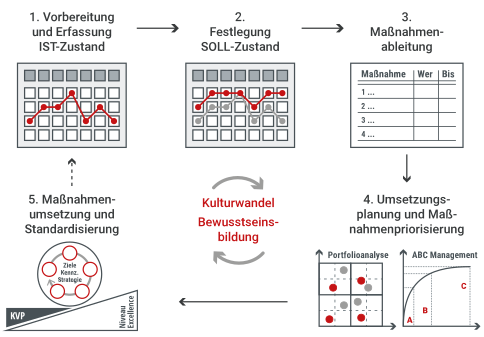
40 measures are defined and prioritised by the project team in order to turn this desired state into reality. Prioritisation is based on a partly data-based, partly experience-based cost/benefit assessment, in which the monetary investment costs or personnel costs are compared with the EBIT effectiveness of the individual measures. The individual measures are summarised below in seven topic-specific packages of measures, which are processed in the course of follow-up projects (Figure 2).
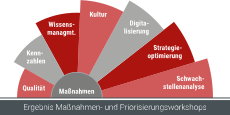
The final stage in the introduction of LSM in the company is the implementation of the measures and the standardisation of the processes that have changed as a result. The realisation of the tasks in the area of key figures - as these form the basis for the introduction and evaluation of further packages of measures - is prioritised.
Weiterführende Literatur
- Biedermann H. (2016): Lean Smart Maintenance: Value-adding, learning-oriented and resource-efficient maintenance. In Biedermann H. (ed.): Lean Smart Maintenance: Concepts, instruments and applications for efficient and intelligent maintenance. Cologne, TÜV Media, ISBN 3-7406-0096-9, pp. 19-29.
- Kinz A. (2017): Design of a dynamic, learning and value-added orientated maintenance. Dissertation, University of Leoben.
- Mertens K., Kinz A., Biedermann H. (2018): Lean Smart Maintenance
- Bernerstaetter R., Biedermann H., et.al. (2018): Status quo of maintenance in Austria: Benchmark study in the DACH region 2012-2017